


Editor’s Note
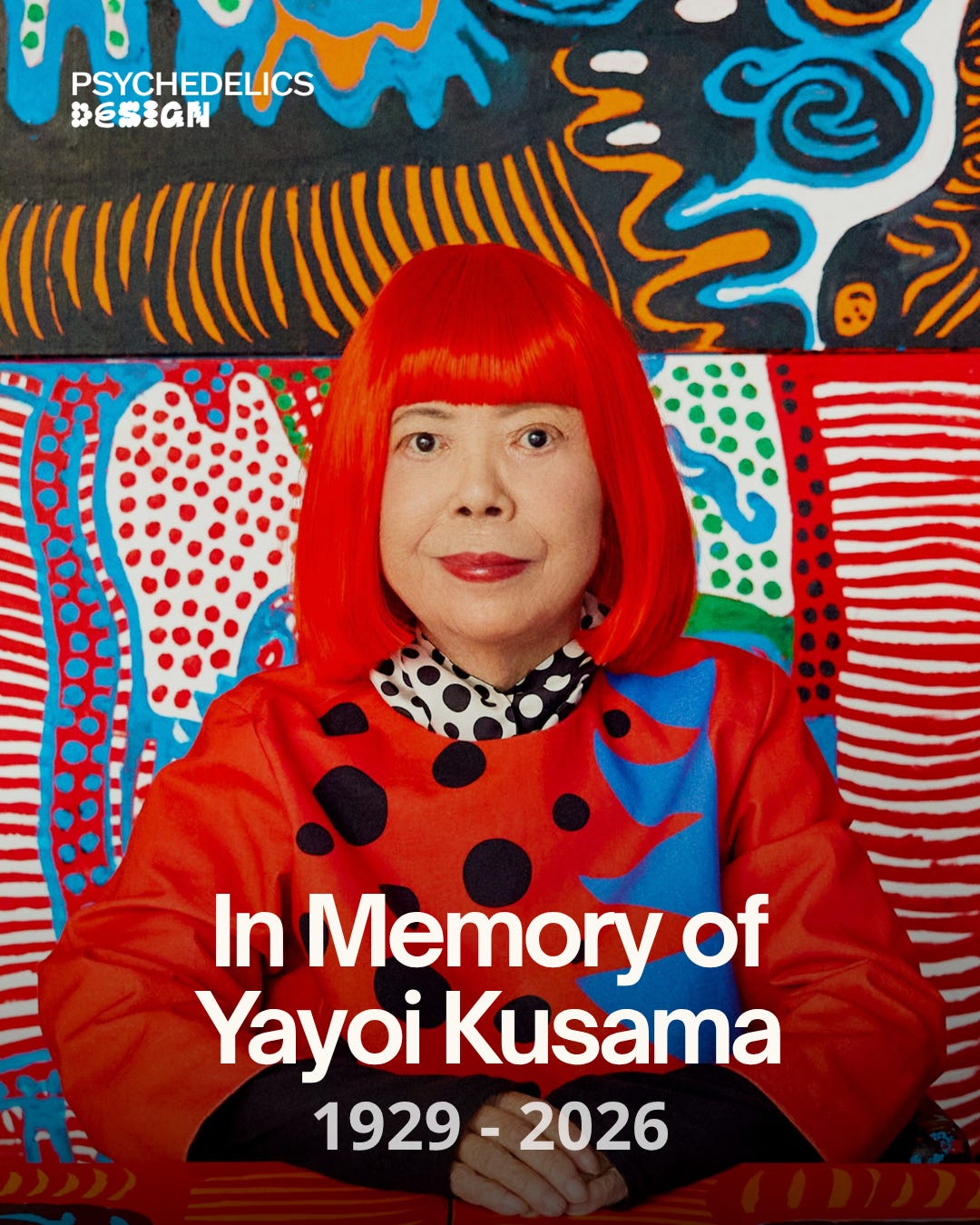
Yayoi Kusama passed away on 14 August, aged 97. She had been having hallucinations since she was ten, and she spent nearly eighty years building containers for them. “If it were not for art, I would have killed myself a long time ago,” she said.
In 1977, she checked herself into a psychiatric hospital in Tokyo that offered art therapy courses and provided Kusama with the stability needed to pursue her projects without distraction. This was a very intentional choice, an artist setting up her set and setting to work best for her.
Six days after her death, the largest single-site psilocybin brain-imaging study ever run was published in Nature. Its finding, put plainly: the “psychedelic brain does not dissolve into pure chaos but reorganises itself around whatever is happening in the room at the time of the experience. Now, Paul Schrader announced to start working on what he calls his “drug movie”. From movie influencing psychedelic experiences and journey impact to movies made to translate experiences. Culture always is a full circle.
And speaking of culture and art as therapy, this year’s online conference we will have experts and researchers such as Co-Director, UCL Centre for Consciousness Research, Christopher Timmermann, talk about ritual and Sam Bloomfield, psychotherapist and MD of PsyEdu will speak with artist Harry Pack, about art as therapy, as a deliberate method to cope and heal.
The container is hugely influencing the experience. It is a working part of it. I could not help myself but already shoot some questions to Harry Pack which you will find in this newsletter amongst news from August.
Warmly,
— Alexandra
ART & DESIGN
• Yayoi Kusama, 1929–2026
Kusama died on 14 August; her studio announced it on the 26th. The obituaries have covered the market records and the queues. The piece worth your time is Rhiannon Lucy Cosslett’s in The Guardian (27 August), which makes a different argument: that Kusama’s refusal to treat her mental illness as something to be hidden — or, equally, as the whole explanation for the work — cleared ground that neurodivergent and disabled artists are standing on now.
For anyone designing psychedelic space, Kusama is the most rigorous case study we have and the one least often cited as design. The Infinity Mirror Rooms were a constructed idea of altered states by an artist controlling every variable: duration, threshold, solitude, exit. Tate Modern kept extending the run and it stayed open nearly three years, because demand would not stop. People queued to spend two minutes inside one woman’s hallucinations, made safe. There is a certain curiosity to experience other realities, but we would like an escape button when things get too much. Kusama never had that button, nor did she know “this might be an eight-hour trip.”
“I fight pain, anxiety, and fear every day, and the only method I have found that relieved my illness is to keep creating art.”
It’s a live debate, and it has two poles — both published in ACS Pharmacology & Translational Science, in the same year, almost as a duel. Olson’s “The Subjective Effects of Psychedelics May Not Be Necessary for Their Enduring Therapeutic Effects,” and Yaden & Griffiths’ “The Subjective Effects of Psychedelics Are Necessary.“ Since then it’s moved from argument to products, designed to deliver the plasticity without the experience, and there’s a 2025 review titled, plainly, “Should we skip the trip?“
On seriousness and respect specifically, I would be pointing at consequence. A bounded, excitable experience is something you visit. An unbounded one is something you undergo, and the irreversibility is doing the work: you can’t leave, so you have to meet things. That’s the mechanism in every initiation rite, and it’s the thing some explicitly are trying to engineer out, maybe on the grounds that the experience is a side effect rather than the mechanism. The pharmacological debate asks whether the trip is necessary for the outcome and for some this might be help without or with less fear of the experience.
The exit is a genuine safety feature that also costs you something, and the design question is how much consequence you can preserve while keeping the door. However, Kusama’s lack of an exit wasn’t a design choice. It was an illness and art her way of coping. Either way, it got me thinking.
• Paul Schrader Announces Ayahuasca Film — Shooting Starts in January
Paul Schrader — at Venice this year with The Basics of Philosophy, executive produced by Martin Scorsese, and the writer of Taxi Driver — told Deadline he starts a new film in January.
Schrader plans to begin his second movie in January. He calls “The Doors Of Perception” his “drug movie,” and says it will use ayahuasca trips to blur the line between a conventional theatrical film and an immersive experience.
RESEARCH
• Psilocybin reorganises the brain around context
Published in Nature on 20 August, Monash University’s PsiConnect study is the largest single-site psilocybin neuroimaging project run to date — five years, 62 healthy adults, fMRI and EEG, scanned at rest and while meditating, listening to music and watching a movie.
So, psychedelics increase entropy and scramble network boundaries – yes – but they also reorganize large-scale brain activity into structured patterns shaped by what the person is doing and experiencing. Those patterns predicted next-day shifts in mood and mindset.
“We’ve shown that the brain isn’t just descending into disorder during a psychedelic experience,” said Professor Adeel Razi. Dr Devon Stoliker added that the work “provides a neural basis for the profound feeling of continuity between self and world that participants often report, which helps to explain how the psychedelic state translates into psychological change”.
Read as a design brief: sound, image, task and environment sit inside the mechanism, not around it. None of which is a new idea — Betty Eisner, Laura Huxley and the architect Kiyoshi Izumi were arguing it in the 1950s and 60s amongst others. I wrote about them here. What’s new is that it now has an imaging dataset behind it.
The team also released the full multimodal dataset as a companion paper in Scientific Data.
Monash release · Paper in Nature · The Conversation, by the authors · Dataset in Scientific Data
BUSINESS & POLICY
FDA, hearing about training, settings and safety — 14 September
Following July’s finalised clinical trial guidance, the FDA holds a public hearing on 14 September (12:30–4:30pm ET, hybrid), with written comments open until 5 October.
FDA and our federal partners are interested in public input on the potential future therapeutic use of psychedelic drugs in supervised and supportive settings, including the following topics: (1) provider training and credentialing, (2) promotion of patient safety, (3) considerations for access, and (4) best practices for data collection and standardization.
The agency has explicitly said it is not taking comment on scheduling, legalisation or non-medical use. It’s the closest to an open door this field has had in some time.
IN CONVERSATION
Harry Pack is a multi-media artist whose fractal landscapes and ethereal figures come out of altered states and out of recovery, in roughly equal measure. He runs The Purple UFO, a roving group format where people bring a piece of their own work and the room reads it back to them.
Is art a psychedelic for you? And if so, do set, setting and integration play a role — what's your version of those in the studio?
I would say, it acts in a very similar way, in that it can be a journey through the self, or through some aspect of reality we’re trying to process. I find it very therapeutic but also uncomfortable at times. It shows me things about myself I might not have expected to learn.
I like to think of ART standing for Abstract Reality Technology — learning to use it as a tool sometimes, instead of as a practice. There are so many things it can do, and the longer you practise, the more refined you become at allowing certain influences in and releasing the things that don’t serve.
I do find setting plays a huge part in the experience. For me, being outside painting in nature is the perfect way to find inspiration and serenity, which in turn enhances the experience. I’ve spent a lot of time doing that, but also fairly isolated in my room — which doesn’t necessarily mean a bad experience. Different, definitely. Lots of factors are involved, but I’d agree there are obvious parallels.
There’s a difference between art that’s therapeutic for the maker and art made as an artist. Do you ever feel those pulling in opposite directions — and which one wins?
There’s a bit of both in what I do, but as with most things it’s a spectrum. Some people work with a more therapeutic approach and others because making art is simply in their nature. I’ve always made art and it’s the main interest I have — but I’ve always felt the therapeutic benefits too, from an early age. I wasn’t very good at communicating when I was younger, and making art gave my thoughts a sense of order.
Someone reading this is in a hard place and hears “art helped me.” What’s the honest version — what did it actually take, and what did it not fix?
When I think of how art has helped me, it’s usually something that happened while I was making the piece: the place I went to in my mind, the lessons or the things I considered along the way. But it’s also the point where you can stand in front of it afterwards and see how it interacts with you. You can change the atmosphere of a space with a piece of art. When we travel we learn new things and become another version of ourselves — the same thing seems to happen with art.
Where could someone start, if they wanted to try making things to process something?
Everyone experiences it differently, so I can only really speak for myself. I have a desire to make art as much as possible, because I like to see how the landscape evolves — a bit like going on a long walk.
Exploring different mediums is a good start. Play around with a few, see which give you the most satisfaction, and ask yourself whether the process taught you anything. I think everyone has the ability to be creative. The more we create, the more this hidden language appears and starts talking back to us. The “Hieroglyphics of the Soul”, maybe.
Harry Pack and Sam Bloomfield discuss Creativity as a Therapeutic Practice at the Creative Biome online conference 6–7 November — the therapist and the artist working the same ground from opposite sides, on where the practices overlap, where they're better kept apart, and what each field has learned that the other hasn't. Sam is a creative arts psychotherapist, clinical supervisor and founding director of Natural Genius and has spent thirty years working through relationship, creativity and nature connection. → Tickets
PSYCHEDELICS DESIGN CONFERENCE – ONLINE NOV 6-7

FROM OUR PARTNERS
• Liquid Culture presents Nutritious All Night: t Release Party
Saturday 19 September, 9pm–4am · Danger Danger, 232 Knickerbocker Ave, Brooklyn
Summer isn’t over until Nutritious says it is. The NYC-raised DJ’s DJ — Liquid Culture founder and A&R, with invitations from the Whitney Museum to Pikes Ibiza — takes over Bushwick’s Danger Danger for seven hours straight, digging deep in the crates to toast Solarmaxxing, his sun-drunk new album, which landed at No. 1 Most Added on the NACC electronic chart.
RSVP: party@liquidculturerecords.com
Instagram · X · Facebook · LinkedIn
ON OUR READING PILE
A new regular section — what we're reading, what's sitting on the table, what doesn't fit neatly into any category but belongs here anyway. More books, films, articles, and resources we've curated with care over the past year live in our free resources library.
• Psychedelics: A Visual Odyssey — Erika Dyck
This book is a global visual history of psychedelics. What makes it useful for designers is that Dyck is tracking how plants and molecules have been pictured and how each of those cultural framings was built by someone, on purpose, for an audience.
• The Doors of Perception — Aldous Huxley
Among the most profound and influential explorations of mind-expanding psychedelic drugs ever written. Huxley’s reflections remain foundational in psychedelic literature. Through mescaline and LSD, he explores vision, consciousness, and the thin veil between ecstasy and madness. This dual volume captures the sacred and the shadow of expanded awareness—a seminal work for seekers, artists, and thinkers alike.
• My Twin the Murderer — Lindsay Kent
My Twin the Murderer is a vividly cinematic psychological thriller that uses the engine of a murder mystery to explore altered consciousness, fractured identity, sisterhood, and the modern war over perception. Set against the shadow of MKUltra, psychedelic experimentation, and today’s climate of disinformation and psychological burnout, the novel asks one central question: who owns your mind?
The book has been submitted to the Psychedelics Design Awards this year and our judges have been raving about it.
More book recommendations can be found in our resources library:
See you in a couple of weeks with the announcement of this year’s design awards finalists. ♡
“The first problem for all of us, men and women, is not to learn, but to unlearn.”
Gloria Steinem
Know a designer, creative director, or agency working adjacent to this space? Forward this to one person who should be reading it.